Masjid Raya Sultan Riau on Penyengat Island
The yellow, thirteen-domed mosque on Penyengat Island is a key legacy of the Riau-Lingga Sultanate and remains an active place of worship today.


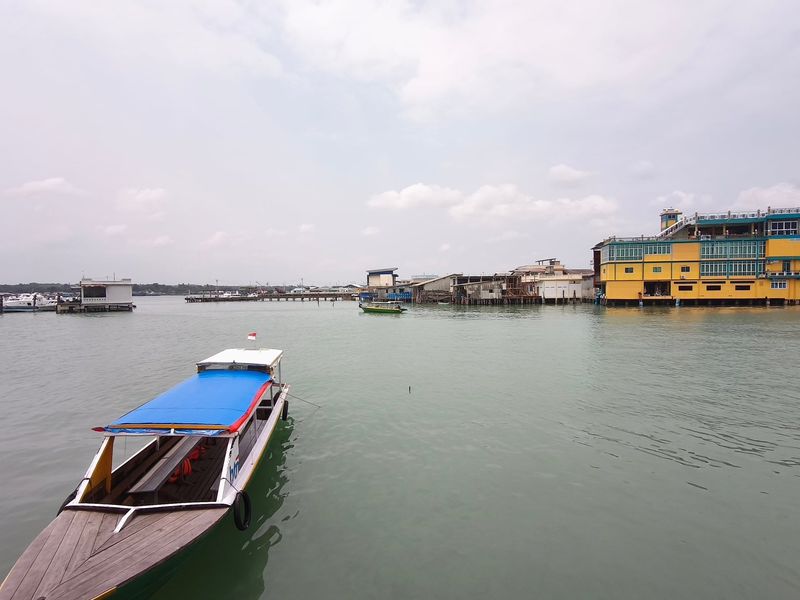
The motorboat crossing from Tanjungpinang harbour to Penyengat Island takes only about fifteen minutes, and even before landing you will notice a bright yellow building on a low rise near the jetty. This is Masjid Raya Sultan Riau, the best-known landmark of an island that was once the political and cultural centre of the Riau-Lingga Sultanate.
History
The first mosque on this site was a simple wooden structure. In 1832, on 1 Syawal 1249 of the Islamic calendar, Raja Abdurrahman, the seventh Yang Dipertuan Muda of Riau, called on the people of Penyengat to rebuild it together. Residents contributed labour, building materials and food for the workers, and the mosque standing today is the result of that expansion.
The egg-white legend
Almost every visitor hears the story of the eggs. According to local tradition, islanders donated so many eggs that the workers grew tired of eating them, and the leftover egg whites were mixed into the lime-and-sand mortar. It is best understood as a cherished local legend rather than a proven construction fact, yet it says a great deal about the community spirit behind the building.
Architecture
The mosque has thirteen domes and four pointed minarets roughly 18.9 metres tall, once used to call the faithful to prayer. Indian influences can be seen in the shapes of the domes and towers. Inside are a teak pulpit made in Jepara and handwritten Qur'an manuscripts, including one by Abdurrahman Stambul dated 1867. The mosque is part of Penyengat's protected cultural heritage area.
Visitor etiquette
- Wear modest clothing covering shoulders and knees; women may wish to bring a scarf for their hair.
- Remove your shoes before entering the prayer hall.
- Avoid visiting during prayer times, especially Friday prayers.
- Ask before photographing worshippers and keep your voice low.
- Do not touch the manuscripts or other displayed objects.
After visiting the mosque, take a walk to the royal tombs and to the grave of Raja Ali Haji, the renowned Malay scholar and writer who is also buried on the island.